
How to Keep Your P2P Ads in the Top Positions 24/7 — the P2P Trading OS Way
Learn the exact strategies P2P merchants use to maintain top positions on Binance and Bybit around the clock — and how to do it automatically without watching the screen.

Maksim
Author
On this page
- How does P2P ad ranking work?
- 1. Price (Primary Factor)
- 2. Completion Rate
- 3. Response Time
- 4. Trade Volume and History
- What's the problem with manual repricing?
- Strategies for Maintaining Top Position
- Strategy 1: Top-of-Book Repricing
- Strategy 2: Second-Best Pricing
- Strategy 3: Spread-Aware Pricing
- Strategy 4: Reference-Rate Tracking
- The Three-Corridor Safety System
- Why is this a system, not a bot?
- Practical Tips for Maximising Top-Position Time
- Optimise Your Response Time
- Keep Your Completion Rate High
- Set Realistic Limits
- Use the AI Agent for Complex Conditions
- What Changes When You Automate
- Frequently Asked Questions
Direct answer: P2P ads rank by price first, then by completion rate and response time. To stay in the top position, your ad must consistently offer a slightly better price than competitors. Doing this manually is unsustainable — automated repricing is the only scalable solution for 24/7 top positioning.
How does P2P ad ranking work?
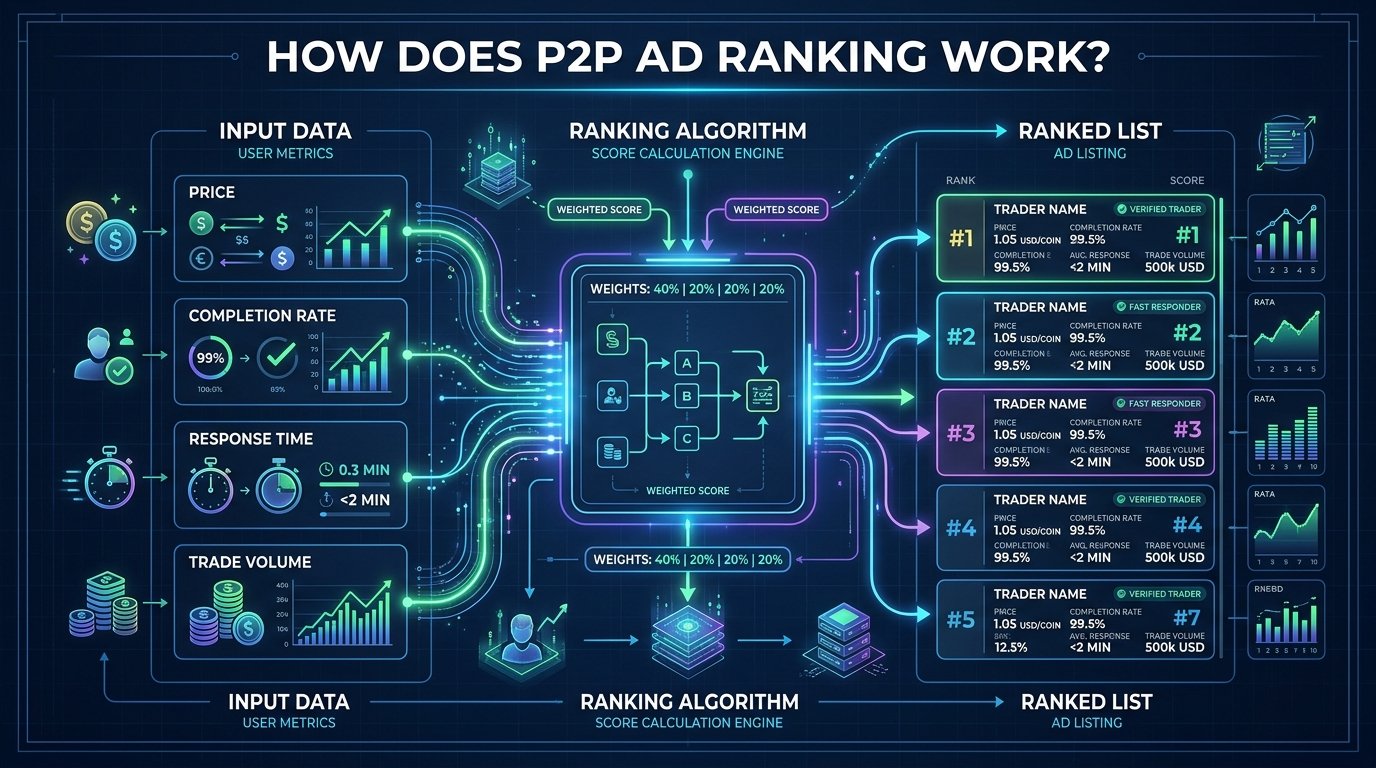
Before building a strategy, it helps to understand what the exchange's ranking algorithm actually considers:
1. Price (Primary Factor)
On both Binance and Bybit, price is the dominant ranking signal. If you are selling USDT for 25,200 VND and your competitor offers 25,205 VND, the buyer sees their ad first. Period.
This means: to rank #1, you need the best price in your direction at any given moment.
2. Completion Rate
A high order completion rate signals reliability. Exchanges typically show a warning when a merchant's completion rate drops below 70-80%, which reduces buyer confidence. Aim to keep yours above 90%.
3. Response Time
Faster average response time improves your ranking. If you respond to chat messages within a minute, this strengthens your position relative to merchants who take 10+ minutes.
4. Trade Volume and History
High lifetime volume and a long track record improve trust signals. New accounts with no history rank lower even if their price is competitive.
What's the problem with manual repricing?
Maintaining the top position manually requires you to:
- Check competitor prices every few minutes.
- Calculate what adjustment keeps you competitive without sacrificing margin.
- Log into the exchange and edit the ad price.
- Repeat this cycle 24 hours a day, 7 days a week.
In practice, no one does this consistently. The result:
| Time of Day | Manual Merchant | Automated Merchant |
|---|---|---|
| 09:00 | Checks, reprices | Already at #1 |
| 11:00 | Misses a shift | Reprices within 5s |
| 14:00 | Away for lunch | Reprices within 5s |
| 02:00 | Sleeping | Reprices within 5s |
| Market spike | Misses it | Captures it |
The opportunity cost of manual management is not theoretical — it directly translates to missed orders and lower monthly volume.
Strategies for Maintaining Top Position
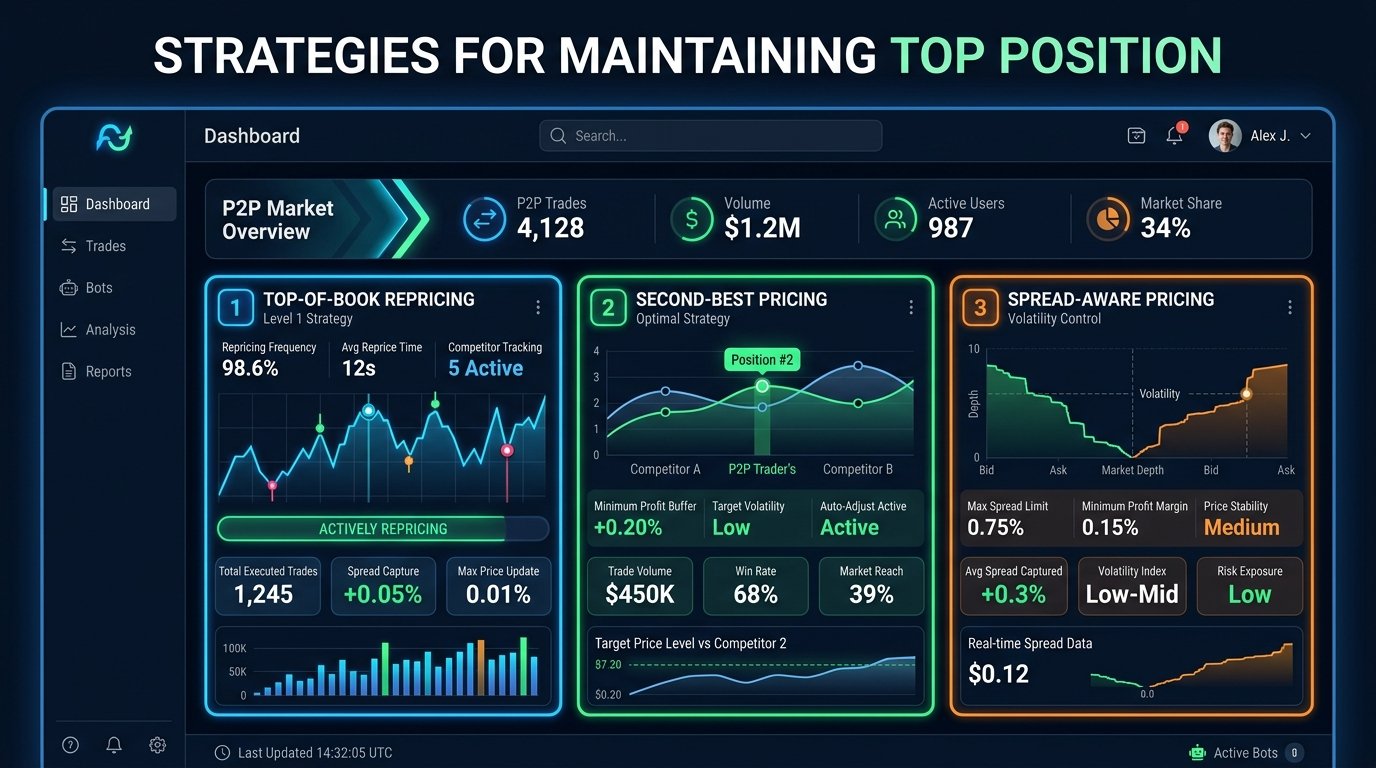
Strategy 1: Top-of-Book Repricing
Set your target to always be 1 tick better than the current best competitor. In most fiat markets, 1 tick = 1 unit of the smallest price increment (e.g. 1 VND on USDT/VND pairs).
Pros: Maximum competitiveness, guarantees #1 position. Cons: Can trigger price wars if a competitor also uses automation.
Use when: Your volume is high enough to absorb thin margins, or when you have a cost advantage (e.g. better exchange rates from your liquidity source).
Strategy 2: Second-Best Pricing
Target position #2 instead of #1. Set your price 1-2 ticks below the current best, not above it. You still get significant order flow (buyers who look at the top 2-3 ads) while preserving slightly better margin.
Pros: Better margin per trade, less price war exposure. Cons: Some order flow goes to the #1 position.
Use when: Margin matters more than raw volume, or during periods of aggressive competition.
Strategy 3: Spread-Aware Pricing
Define a minimum spread (e.g. 0.3%) between your buying and selling prices. If the spread in the market compresses below this threshold, Pilotbot pauses your ads automatically rather than continuing to compete at unprofitable levels.
Pros: Protects profitability, avoids trapping yourself in losing trades. Cons: You go offline during compression events.
Use when: You are a professional merchant where margin discipline is critical.
Strategy 4: Reference-Rate Tracking
Instead of competing against other ads, peg your price to an external reference rate (e.g. Binance spot price + a fixed percentage). Your ad price floats with the underlying market automatically.
Pros: Independent of competitor behavior, reflects fair value. Cons: May not always be the best price in the book.
Use when: You want a low-maintenance, stable approach.
The Three-Corridor Safety System
Regardless of which strategy you use, Pilotbot's pricing layer applies a three-layer price safety system to every update:
-
Hard corridor (±19.9%): The absolute limit. No price update will ever move outside this band relative to the market reference rate. This prevents catastrophic mispricing due to bugs, bad data, or market dislocations.
-
Soft corridor: Your personal band, e.g. ±3%. The system won't compete outside this range even if a competitor's price is technically better.
-
Fallback price: If no competitors are in range and the market is illiquid, the pricing layer holds your ad at the boundary of your soft corridor rather than leaving it at a stale price. If the connection to the exchange is lost entirely, the ad is paused instead of staying live with an outdated price.
This system means you can set up automation confidently — the price will always be reasonable, even in edge cases.
Why is this a system, not a bot?
A single repricing script is a bot: it has one job, and no defined behavior for what happens when its inputs go bad. Pilotbot is built as a P2P Trading OS because holding a top position safely requires more than repricing logic — it requires a system that knows what to do when the market data looks wrong, when the exchange connection drops, or when two updates for the same ad arrive at once. The corridor system above, plus pausing ads instead of leaving them stale on disconnect, are the operating-system properties that a plain repricing bot typically does not have.
Practical Tips for Maximising Top-Position Time
Optimise Your Response Time
Even with perfect price automation, a slow response time will cost you ranking. Enable notifications on your phone and aim to respond to new orders within 1-2 minutes during your active hours.
Keep Your Completion Rate High
Never cancel an order unless absolutely necessary. Each cancellation hurts your completion rate and your ranking. If you know you will be unavailable for an extended period, pause your ads rather than cancelling live orders.
Set Realistic Limits
Define minimum and maximum order amounts that you can actually fulfil consistently. Ads with wide ranges but frequent partial cancellations hurt your metrics more than ads with narrower ranges and perfect execution.
Use the AI Agent for Complex Conditions
Pilotbot's AI agent can respond to nuanced market conditions. For example: "Increase my spread by 0.2% between 23:00 and 07:00 when liquidity is low" or "Switch to reference-rate tracking if I haven't had an order in 4 hours". Describe your logic in natural language and the AI builds the strategy.
What Changes When You Automate
Switching from manual to automated repricing changes the shape of your day rather than just the numbers on your dashboard:
- More time spent at #1 — the ad is repriced continuously instead of whenever you happen to check, so it holds a competitive position for a larger share of the day.
- Less hands-on management — the strategy is set once through the AI agent instead of being adjusted manually throughout the day.
- Fewer rushed cancellations — because the price stays current, you are less likely to get caught by a stale ad and have to cancel.
Frequently Asked Questions
How quickly does Pilotbot reprice my ad? The repricing cycle runs every 5-10 seconds. From the moment a competitor changes their price to when your ad is updated is typically under 10 seconds.
Can I set different strategies for different pairs? Yes. Each of your ads can have its own strategy, corridor, and price mode. A USDT/VND sell ad and a USDT/THB buy ad can behave completely independently.
What happens during extreme market volatility? The hard corridor (±19.9%) acts as a circuit breaker. If the reference rate moves sharply, Pilotbot will not chase the market outside your configured band. Your ads will either hold at the corridor boundary or go offline if the market moves too far, depending on your fallback settings.
Does top-position automation work during off-hours? Yes — that is its primary advantage. Competitors who manage manually are essentially offline at night. Automated merchants capture all order flow during those hours.
Ready to automate? Start your 14-day free trial — no credit card required.
Automate P2P Trading and Keep Top Order Book Positions 24/7
Get 28 days of Light plan free instead of 14 with the exclusive promo code below. No credit card required.
Maksim
Founder, Pilotbot
Builds Pilotbot, a P2P Trading OS for merchants running advertisements across Binance P2P and Bybit P2P. Works on automated pricing, ad positioning and exchange connectivity.