How P2P Order Completion Rate Impacts Your Ad Position (and How Pilotbotnet Protects Your Rating)
Learn how Completion Rate dictates your ad visibility on Binance, Bybit, OKX, and HTX, and how Pilotbotnet's high-tech Zero Manual ecosystem automates the entire trade lifecycle.

Maksim
Author
On this page
- What is Completion Rate and Why Does It Matter?
- The Impact of Ratings on 4 Key Exchanges
- The "Zero Manual" Pipeline: 4 Layers of Total Automation
- 1. AI-Repricing: Protecting Position and Margin
- 2. AI Chat Agent: Smart Negotiation
- 3. AML/KYC Verification: Shutting Down Triangular Scams
- 4. Bank API (Auto-release): Reclaiming Your Time
- The Compounding Growth Flywheel
- Your New P2P Reality

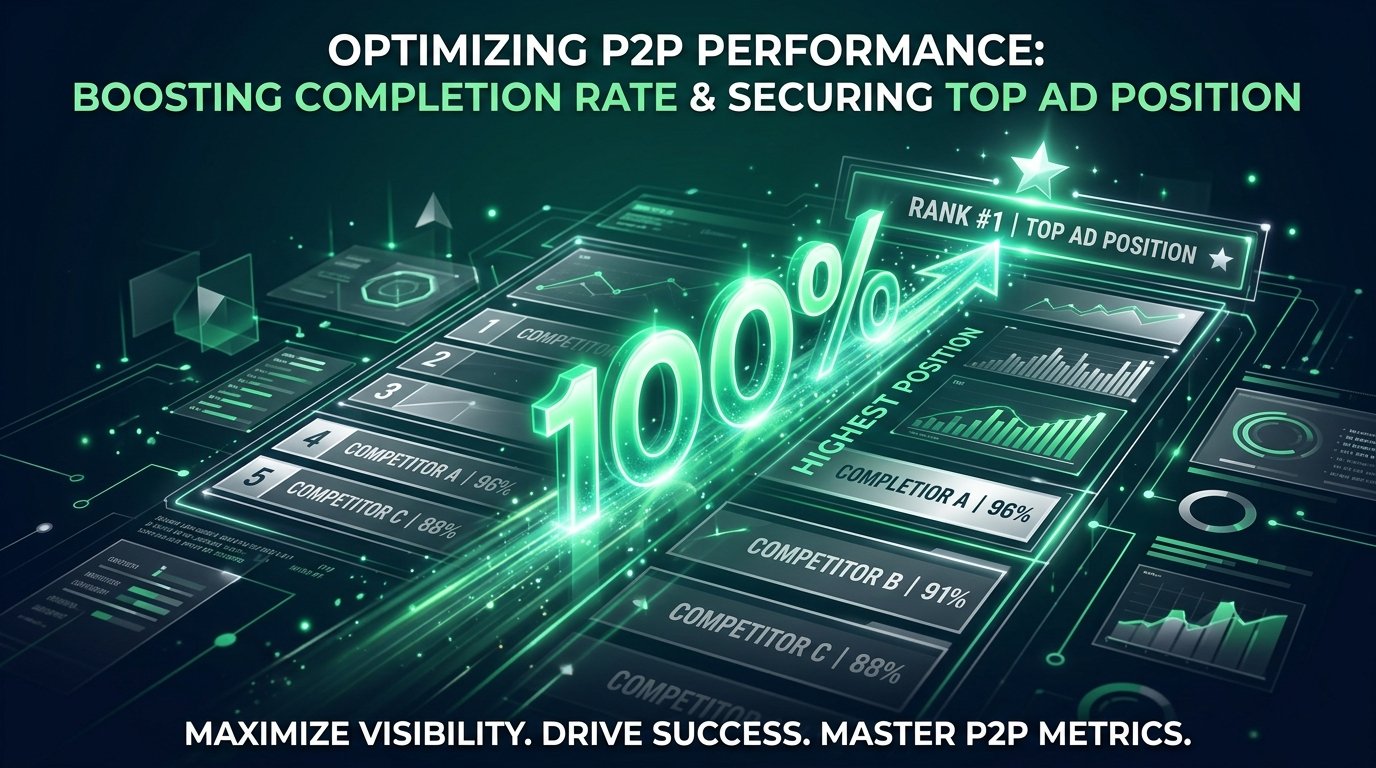
Your P2P order completion rate is not just a cosmetic metric in your profile. It is a critical factor governing the visibility of your ads on top tier crypto exchanges. When this metric drops below a critical threshold, not even the most competitive price will save you from losing clients.
In this article, we examine how visibility algorithms operate on Binance, Bybit, OKX, and HTX, and demonstrate how the high-tech Pilotbotnet SaaS ecosystem enables you to maintain a rock-solid 100% completion rate while completely automating your entire P2P trading cycle, freeing you from sleepless nights.
What is Completion Rate and Why Does It Matter?
Completion rate is a reliability metric: the proportion of successfully completed orders relative to total opened orders. The formula is straightforward:
Completion Rate = Completed Orders / (Completed Orders + Canceled Orders) × 100
Every trade cancellation, regardless of who initiated it, inflicts damage on your rating. Buyer sent money from a third-party card? Cancel. Scammer stalling for time? Cancel.
The Impact of Ratings on 4 Key Exchanges
Pilotbotnet officially supports Binance, Bybit, OKX, and HTX. Algorithms across all four platforms penalize low completion rates without mercy:
- Below 80%: Your account effectively falls into a "shadowban". Buyers with default filter settings will simply never see your ads.
- 80%–90%: Baseline visibility. You can compete, but seasoned merchants and professional traders will filter out your ads.
- Above 90% (ideally 95%+): Maximum trust tier. Your ads are visible to all users, and the exchange algorithms (especially on Bybit and OKX) frequently prioritize your placement over slightly cheaper offerings from novice sellers.
The "Zero Manual" Pipeline: 4 Layers of Total Automation
Manual trading inevitably leads to human fatigue, delays, and rating drawdowns. The Pilotbotnet ecosystem is not a primitive repricing script; it is a powerful four-stage "Zero Manual" pipeline that systematically closes every operational loophole.
We support ALL fiat pairs and ALL payment methods available on these exchanges — whether it's NGN, THB, RUB, EUR, or any other currency.
1. AI-Repricing: Protecting Position and Margin
The Problem: While you stepped away, the market moved. A buyer opens an order at an unfavorable price, forcing you into a cancellation. The Solution: Pilotbotnet's algorithms keep your ad in the TOP-1 spot 24/7 with millisecond response times. Your price is always economically calibrated and current, eliminating cancellations caused by market drift.
2. AI Chat Agent: Smart Negotiation
The Problem: Scammers frequently attempt to extract payment details without intending to pay. The Solution: Our advanced chat agent autonomously communicates with buyers, handles objections, and politely requests payment receipts. Crucially, the AI never releases your payment credentials on its own initiative, cutting off phishing and manipulative social engineering attacks.
3. AML/KYC Verification: Shutting Down Triangular Scams
The Problem: Funds arrive from an unverified third party. You waste hours coordinating refunds and cancellations. The Solution: Prior to revealing payment details, strict verification activates (seamless integration with Didit or automated "selfie + ID" verification directly in chat). The system checks names and vets users against databases. Only when verification status changes to "passed" does the deterministic system layer securely inject your bank details or QR code into the chat. Scammers never reach this phase.
4. Bank API (Auto-release): Reclaiming Your Time
The Problem: An order opens in the middle of the night. You're asleep, the timer expires, the exchange cancels the transaction, and your rating takes a hit. The Solution: You no longer need to wake up at 3 AM for a $50 order — the bank API will verify the incoming payment, match the sender's name, and release crypto in 12 seconds! We integrate directly with banks via secure webhooks (Stark Bank / Pix, Tinkoff, Monobank). The system matches both the exact amount and the tax ID / sender name (Confirmation of Payee). When data aligns perfectly, the system automatically triggers "Release Crypto".
The Compounding Growth Flywheel
Protecting your completion rate generates a compounding growth flywheel for your business:
- AI-Repricing guarantees TOP-1 → you capture maximum volume and buyer flow.
- Zero Manual Pipeline blocks scammers and instantly services legitimate clients → your completion rate locks in at 99–100%.
- High Account Trust → Binance, Bybit, OKX, and HTX grant you even higher search ranking priority.
Rebuilding a compromised rating is arduous — clawing back from 75% to 90% demands dozens of flawless, consecutive transactions. Protecting your rating from day one is far easier and vastly more profitable.
Your New P2P Reality
Standalone price-repricing bots belong to the past. Dominating Binance, Bybit, OKX, and HTX requires a full-fledged operating system capable of handling the entire trade lifecycle — from sub-second spread optimization to banking webhook reconciliation.
Protect your Completion Rate, scale your capital, and sleep peacefully while Pilotbotnet runs your trading operations.
Automate P2P Trading and Keep Top Order Book Positions 24/7
Get 28 days of Light plan free instead of 14 with the exclusive promo code below. No credit card required.
Maksim
Founder, Pilotbot
Builds Pilotbot, a P2P Trading OS for merchants running advertisements across Binance P2P and Bybit P2P. Works on automated pricing, ad positioning and exchange connectivity.