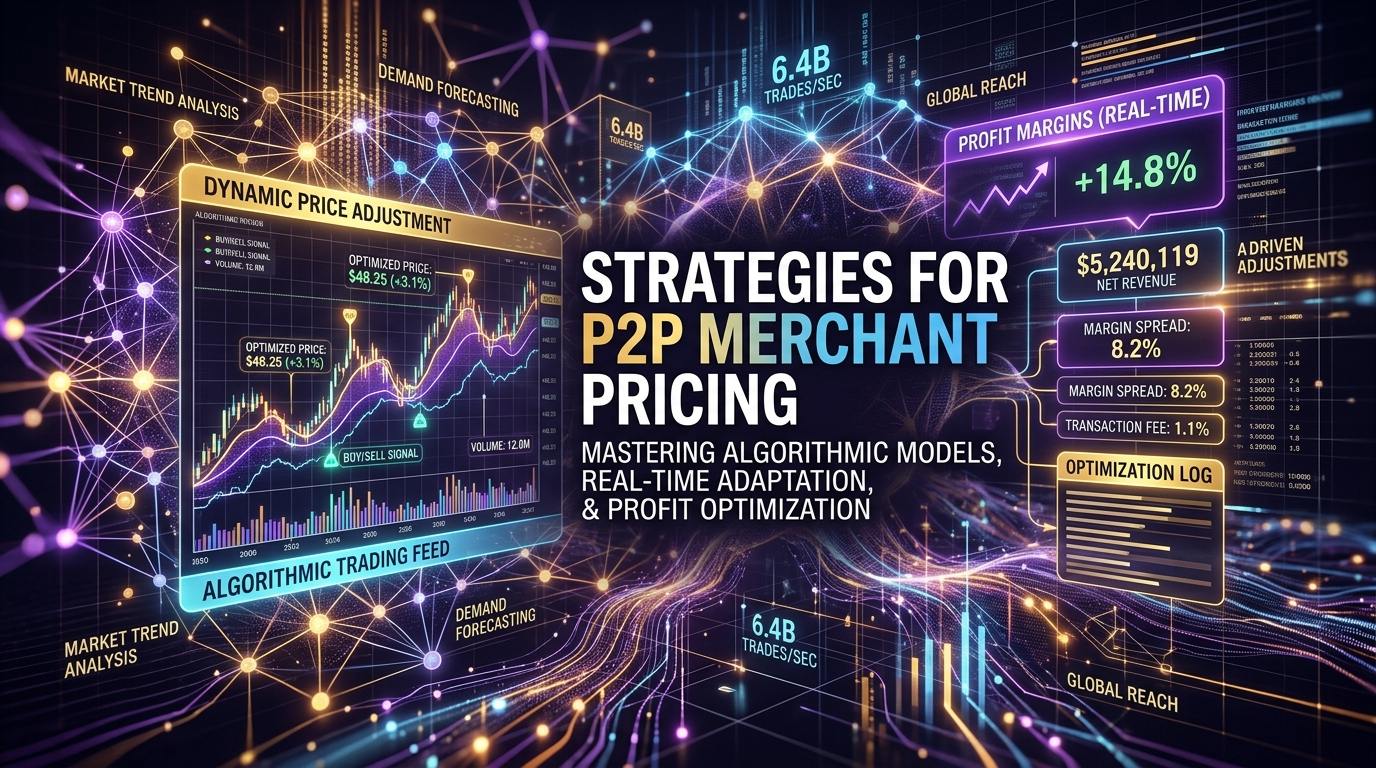
Zero Manual: 4-Stage Strategy for Complete P2P Merchant Automation
P2P automation is much more than repricing. Learn how the Pilotbotnet ecosystem with AI, AML/KYC, and bank APIs eliminates manual work on Binance, Bybit, OKX, and HTX.

Maksim
Author
On this page
- The "Zero Manual" Pipeline: Core Value in Modern P2P
- Step 1. AI-Repricing: Holding Top-1 in Milliseconds
- Step 2. AI Chat Agent: Hands-Free Counterparty Engagement
- Step 3. AML/KYC Verification: Ironclad Defense Against Fraud
- Step 4. Bank APIs and Instant Auto-Release
- High-End SaaS Ecosystem for Market Leaders

Short answer: The optimal pricing strategy in modern P2P is the complete elimination of manual intervention. As your trading operation grows, simply adjusting prices no longer solves the scaling bottleneck. True efficiency lies in an integrated infrastructure.
Meet the Pilotbotnet high-end SaaS ecosystem. We officially support 4 leading crypto exchanges: Binance, Bybit, OKX, and HTX, and absolutely all fiat pairs and payment methods available across these platforms (whether it's NGN, THB, or RUB). In this article, we break down the "Zero Manual" concept — a four-stage pipeline that converts trading into a fully autonomous business.
The "Zero Manual" Pipeline: Core Value in Modern P2P
Most P2P merchants assume automation ends with a script that outbids a competitor's price. In truth, genuine automation is an integrated ecosystem composed of four unbreakable steps.
You no longer need to wake up at 3 AM for a $50 order — the bank API will verify the incoming payment, match the sender's name, and release crypto in 12 seconds. Let's see how this works in practice.
Step 1. AI-Repricing: Holding Top-1 in Milliseconds
In competitive order books, margins can be thin, making trade turnover volume the decisive factor. Our AI repricing engine enables you to hold the Top-1 position 24/7 with millisecond latency.
Regardless of whether you trade on Binance, Bybit, OKX, or HTX, the algorithm instantly processes competitor adjustments. Rather than engaging in an indiscriminate race to the bottom, it operates within strict profitability boundaries you define. Your ad remains the most attractive to buyers without sacrificing your bottom-line profit.
Step 2. AI Chat Agent: Hands-Free Counterparty Engagement
The moment an order is initiated, the autonomous AI agent takes over. It:
- Instantly welcomes the buyer in their native language.
- Addresses counterparty concerns and answers standard questions.
- Automatically requests payment receipts and proof of transfer.
Critical security mandate: The AI agent NEVER sends payment credentials on its own. It is solely responsible for communication and preparing the client for the subsequent phase. This eliminates social engineering attack vectors entirely.
Step 3. AML/KYC Verification: Ironclad Defense Against Fraud
Scams and triangular fraud are the primary threats to any P2P merchant. Pilotbotnet neutralizes this threat via built-in integration with Didit or an automated "selfie + ID" workflow directly inside the chat.
The system verifies customer names and screens credentials across databases. Only when the verification status transitions to passed does the system's deterministic layer securely inject your bank details (or QR code) into the chat.
The result: Fraudsters never see your credentials, and your bank cards and accounts remain shielded from blocks and freezes.
Step 4. Bank APIs and Instant Auto-Release
The final and most impressive phase of the pipeline is direct integration with banking institutions (such as Stark Bank / Pix, Tinkoff, Monobank) via secure webhooks.
As soon as funds land in your account, the system executes a strict Confirmation of Payee protocol:
- Reconciles the incoming amount down to the exact cent.
- Cross-references the sender's Name and Tax ID with the exchange-verified counterparty identity.
If there is a 100% match, the system automatically triggers the "Release Crypto" command. Your transaction completes flawlessly and instantaneously while you sleep or focus on strategic initiatives.
High-End SaaS Ecosystem for Market Leaders
Supporting all fiat pairs and payment methods across Binance, Bybit, OKX, and HTX unlocks unlimited scaling potential. The "Zero Manual" approach transforms your trading account from a manual labor workstation into an uninterrupted financial gateway.
Invest in the right infrastructure, rely on mathematics and AI, and allow Pilotbotnet to handle the routine.
🔥 Read also: Calculating Spread in P2P Arbitrage: Fee Calculator
Automate P2P Trading and Keep Top Order Book Positions 24/7
Get 28 days of Light plan free instead of 14 with the exclusive promo code below. No credit card required.
Maksim
Founder, Pilotbot
Builds Pilotbot, a P2P Trading OS for merchants running advertisements across Binance P2P and Bybit P2P. Works on automated pricing, ad positioning and exchange connectivity.