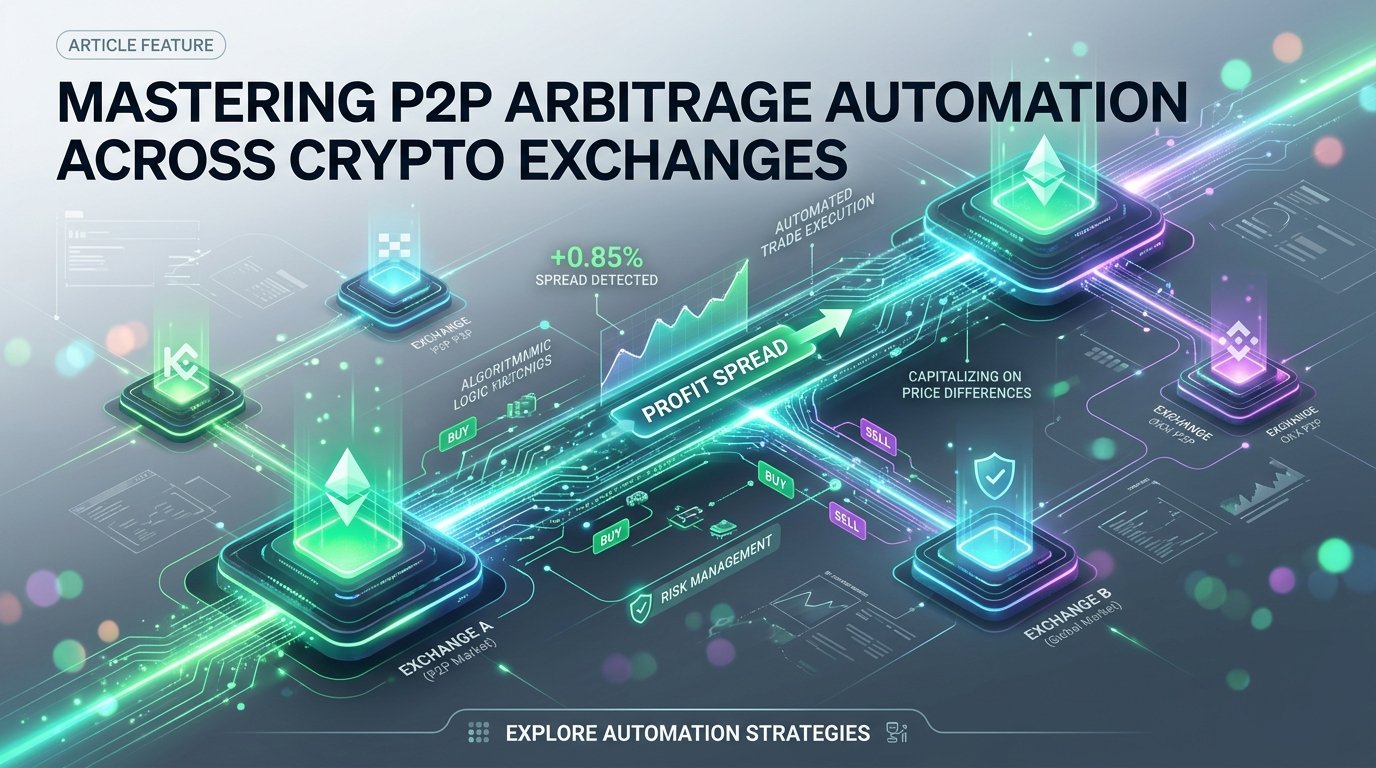
P2P Arbitrage Automation 2.0: 'Zero Manual' Pipeline and Trading OS
How Pilotbotnet transforms P2P arbitrage into an autonomous business. AI repricing, smart chat agent, KYC verification, and bank API auto-release on Binance, Bybit, OKX, and HTX.

Maksim
Author
On this page
- What is the 'Zero Manual' Pipeline? (Core Value)
- 1. AI-Repricing (Retaining TOP-1)
- 2. Smart AI Chat Agent
- 3. AML/KYC Verification
- 4. Bank API (Auto-release)
- Complete Operational Freedom: Exchanges and Payment Methods
- Arbitrage Scanner vs. Trading OS (Pilotbotnet)
- Why Manual Arbitrage No Longer Works
- Pre-Launch Security Checklist

Direct answer: Modern P2P arbitrage automation is no longer just a price-updating script. It is a full-featured operating system that manages the entire trade lifecycle: from keeping your ad at TOP-1 in the order book to counterparty communication, verification, and automated crypto release. This is the Zero Manual concept, where your personal time is no longer a bottleneck for scaling your P2P business.
What is the 'Zero Manual' Pipeline? (Core Value)
You no longer need to wake up at 3 AM for a $50 order — the bank API will verify the incoming payment, match the sender's name, and release crypto in 12 seconds. Real automation in the Pilotbotnet ecosystem consists of 4 integrated stages:
1. AI-Repricing (Retaining TOP-1)
The system analyzes the order book 24/7 with millisecond latency. Your spread no longer evaporates because you stepped away for five minutes. The algorithm doesn't just trail the market — it intelligently outbids competitors, ensuring your ads remain in the most profitable positions while safeguarding your minimum margin (Spread-protect).
2. Smart AI Chat Agent
Autonomously greets the buyer, handles objections, and requests receipts. Most importantly: The chat agent NEVER sends payment details on its own. This is a fundamental security principle that eliminates human error and scripting risks.
3. AML/KYC Verification
Before a client sees your payment details, they undergo verification. This can be a seamless integration with Didit or a classic "selfie + ID" request directly in the chat. The system verifies names and checks records across databases. Only when verification has the 'passed' status does Pilotbotnet's deterministic layer inject payment details (or a QR code) into the chat. Fraudsters walk away empty-handed because they never receive payment coordinates.
4. Bank API (Auto-release)
The era of manual mobile banking checks is over. Thanks to bank API integrations via webhooks (e.g., Stark Bank / Pix, Tinkoff, Monobank), Pilotbotnet detects payments instantly. The system strictly reconciles the transaction amount AND the sender's Name/Tax ID (Confirmation of Payee). If there is a 100% match, the algorithm automatically executes "Release Crypto". The entire process from fund arrival to order completion takes seconds.
Complete Operational Freedom: Exchanges and Payment Methods
Pilotbotnet is a high-end SaaS ecosystem that removes artificial limits.
- Supported Exchanges: We officially support 4 leading crypto exchanges: Binance, Bybit, OKX, and HTX. You can distribute liquidity and manage spreads across any of them through a single unified interface.
- Any Fiat Pairs and Payment Methods: Pilotbotnet works with ALL fiat pairs and ALL payment methods available on these 4 exchanges. Whether it's NGN, THB, RUB, EUR, or exotic local e-wallets — you can trade whatever exists on the platform.
Arbitrage Scanner vs. Trading OS (Pilotbotnet)
Many confuse arbitrage scanners (which only search for price discrepancies and send alerts) with real automation.
| Feature | Arbitrage Scanner | Pilotbotnet Trading OS |
|---|---|---|
| What it does | Alerts on spreads (you do everything manually) | Automates the ENTIRE cycle from pricing to crypto release |
| Bank interaction | None | Yes (webhooks, auto-reconciliation, auto-release) |
| Customer chat | None | AI agent conducts dialogue and collects receipts |
| Verification (KYC) | None | Protection against triangular scams, fraudsters never see payment details |
| Best suited for | Manually chasing rare windows | Systematic, scalable 24/7 P2P enterprise |
Why Manual Arbitrage No Longer Works
The P2P market has become too fast. Doing everything by hand means:
- Losing sleep during night hours when spreads are widest.
- Constantly catching account freezes due to dirty fiat (because you lack time to verify each counterparty).
- Missing orders while logging into banking apps to check payments.
The outcome of automation isn't incidental earnings — it is consistency. A modest spread multiplied by hundreds of automated transactions per day compounds into significant capital.
Pre-Launch Security Checklist
- Never grant withdrawal permissions. Pilotbotnet operates via API keys restricted strictly to read and ad management permissions.
- Enable Spread-protect. The system pauses ads if the spread narrows below your minimum target margin.
- Enable strict KYC. Mandatory name matching protects your bank accounts and cards from freezes and triangular scams.
Ready to switch your P2P business into autonomous mode? Learn more about the Zero Manual concept at pilotbot.net or start scaling right now.
Automate P2P Trading and Keep Top Order Book Positions 24/7
Get 28 days of Light plan free instead of 14 with the exclusive promo code below. No credit card required.
Maksim
Founder, Pilotbot
Builds Pilotbot, a P2P Trading OS for merchants running advertisements across Binance P2P and Bybit P2P. Works on automated pricing, ad positioning and exchange connectivity.