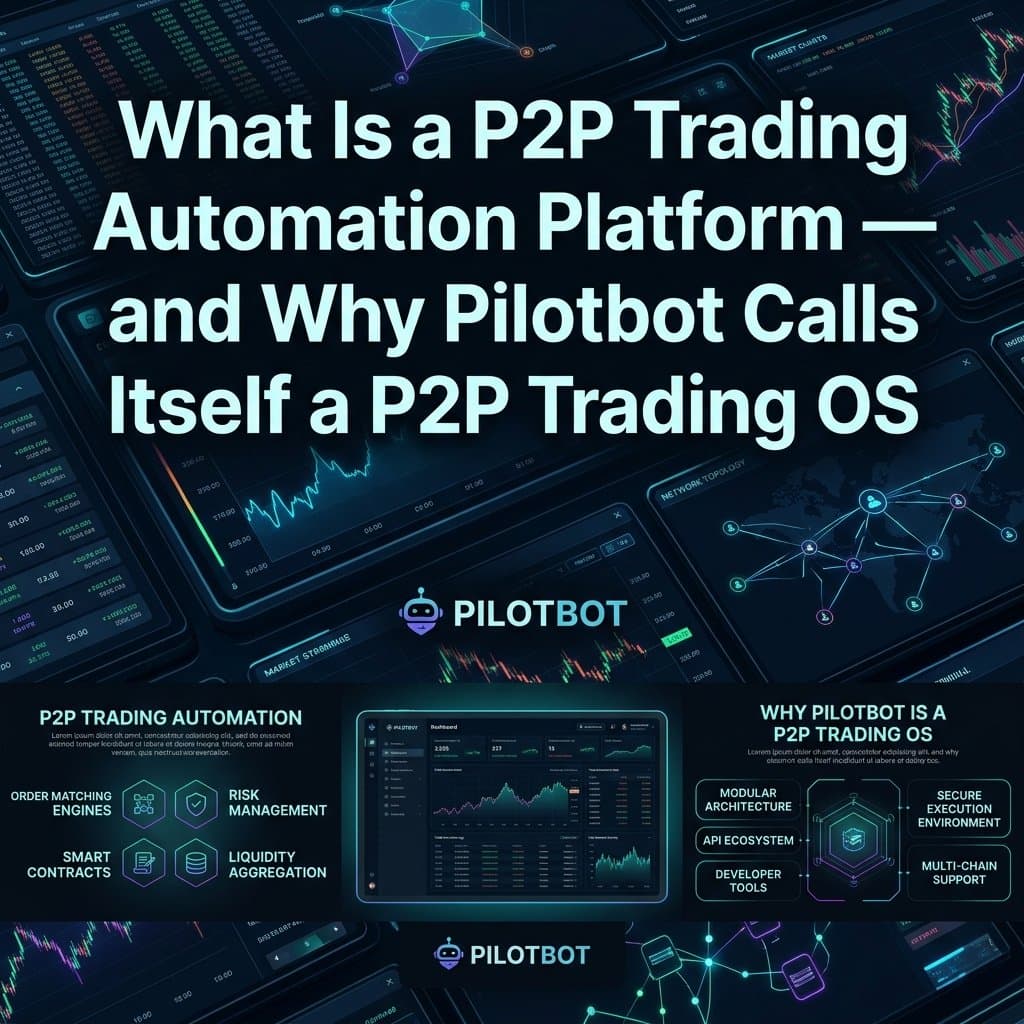
What Is a P2P Trading Automation Platform — and Why Pilotbot Calls Itself a P2P Trading OS
Understand what P2P trading automation platforms do, how ad repricing differs from arbitrage scanners, and when automation delivers real ROI for P2P merchants.

Maksim
Author
On this page
The short answer: A P2P trading automation platform manages your buy/sell advertisements on exchanges like Binance and Bybit automatically — adjusting prices in real time to maintain competitive position and volume. It is not a scanner that looks for arbitrage opportunities between exchanges; it is a tool that makes your existing ads more competitive without manual effort.
What are the two types of tool people mean by "P2P bot"?
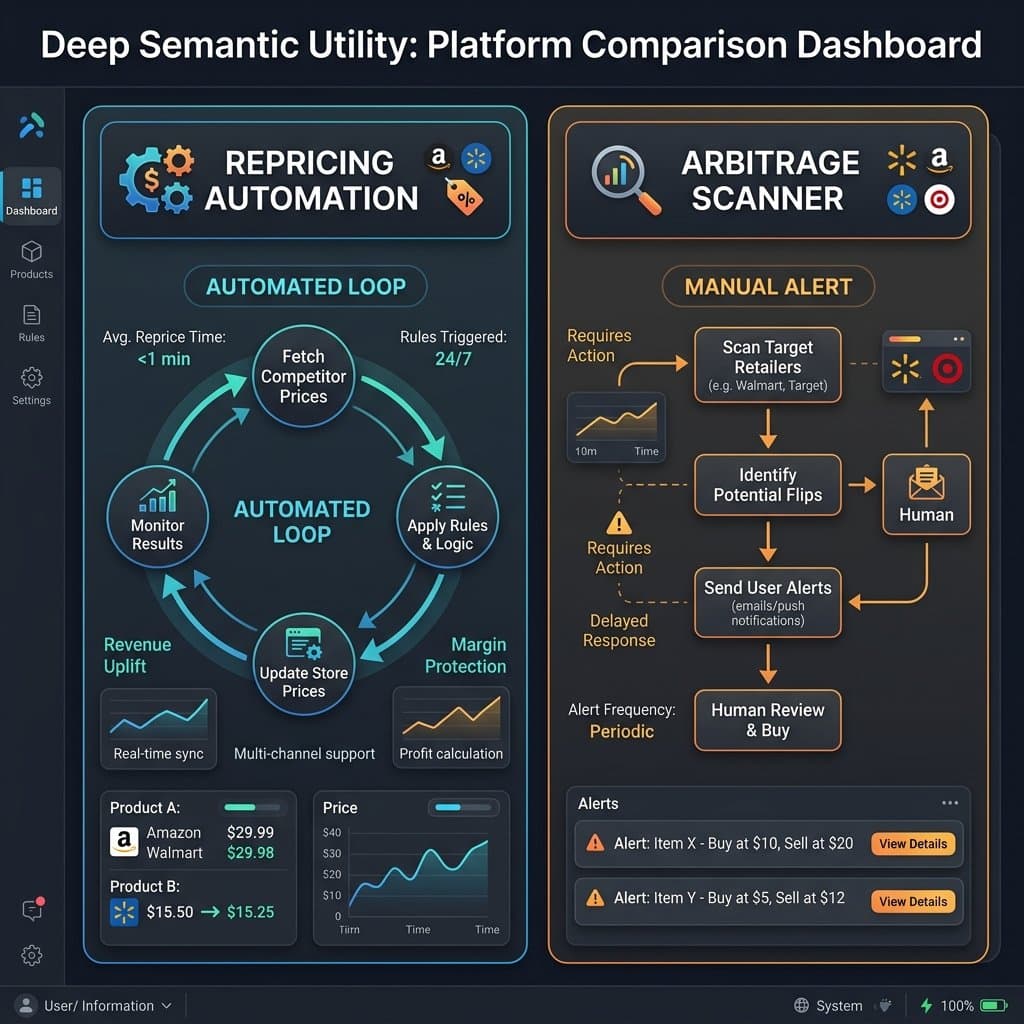
When people search for "P2P bot," they usually mean one of two very different product categories. Understanding the distinction will help you pick the right tool — or understand why one type works for you and the other does not.
| P2P ad repricing platform (what Pilotbot does) | P2P spread/arbitrage scanner | |
|---|---|---|
| What it does | Connects to your exchange account via API, reads the current best competitor offers every few seconds, and automatically updates your ad price to stay at the top of the order book, inside safety corridors, running 24/7 even when you are offline | Watches both the buy side and the sell side of a P2P market (or multiple markets) looking for moments when the gap between the best buy offer and the best sell offer is wide enough to profit from |
| Who it is for | Established P2P merchants who already have capital, payment methods, and volume — and want to stop losing orders to automated competitors | Traders with capital available on both sides of a pair (or on two exchanges), looking for short windows of spread opportunity |
| How you act on it | Acts for you continuously | Tells you when to act — execution is typically manual or semi-automated |
| What it does NOT do | Does not find buyers or sellers for you, move funds between exchanges, or require capital on multiple platforms | Does not run your ads or reprice for you |
Most active P2P merchants benefit from repricing automation, not spread scanning — because maintaining top position drives consistent daily volume, while spread windows are infrequent and require manual execution.
Bot, Platform, or Operating System — Why the Word Matters
Both categories above get called "bots" in casual conversation, and the word is not wrong exactly — it is just too small for what a serious tool needs to do. A bot is a script that places trades or edits a price for you. An operating system is the layer everything else on your P2P desk depends on: it has its own safety model (the price corridors), its own state (which ad belongs to which process right now), its own permissions (API keys scoped to ad management only), and — critically — its own defined behavior when something breaks.
That last part is where a plain bot usually falls short. If a repricing script loses its connection to the exchange, the typical outcome is that the ad it was managing is simply left at its last price, drifting further from the market the longer the outage lasts. Pilotbot is built as a P2P Trading OS rather than a single script specifically to close that gap: the pricing layer pauses affected ads on a lost connection instead of leaving them live and stale, the execution layer uses per-ad locking so two processes can never write to the same ad at once, and strategy always runs inside the corridors described below rather than being able to override them.
This is why Pilotbot's own positioning uses "P2P Trading OS" instead of "bot" or "automation platform" — not to avoid the word people search for, but because the operating-system properties above are the actual reason the tool is safe to run unattended.
What does a repricing platform actually do, technically?
Here is the precise flow that runs in a platform like Pilotbot:
- Market read — Every cycle (typically 5–10 seconds), the platform reads the current order book for your pair and direction.
- Position detection — It determines where your ad currently sits (position 1, 2, 7, etc.).
- Target price calculation — Based on your configured strategy, it calculates the price needed to reach your target position. If you already hold position #1, no update is needed.
- Corridor validation — Before any price update, the new price is validated against your corridor rules. If it would breach your soft or hard boundary, the update is rejected and a fallback price is used instead.
- API update — The validated price is sent to the exchange via official API. Your ad is updated.
- Logging — Every update is recorded with timestamp, price before/after, reason, and resulting position.
This entire cycle completes in under a second. Over 24 hours, repricing every 5–10 seconds means roughly 8,600–17,000 automated decisions, versus the handful of times a person could realistically check by hand in a day.
When does automation deliver clear ROI?
Automation delivers the clearest return in these scenarios:
High-competition pairs. In USDT/VND on Binance, there can be dozens of active merchants in a sell direction. Being #1 vs #7 is the difference between capturing most of the buyer demand and capturing very little of it.
Overnight and holiday volume. If your local working hours are 09:00–21:00, you miss 12 hours of potential orders per day without automation. Over a month, that is 360 hours of unmanaged exposure.
Market rate changes. When the fiat reference rate moves (e.g. central bank announcement, currency news), the entire P2P order book shifts. Manual merchants are out of position for minutes to hours. An automated merchant adjusts within seconds.
Multiple concurrent ads. Managing 3–5 ads manually is exhausting. Automation handles all of them simultaneously with no additional time cost.
What is a P2P automation platform NOT?
To be specific about what Pilotbot and similar tools do not do:
- Not a fund manager. It does not move your capital, allocate balance, or make investment decisions.
- Not an order executor. It does not place buy/sell orders on your behalf. P2P trades are still completed by you (or with your manual release/confirmation).
- Not an arbitrage bot. It does not scan for cross-exchange price differences or execute arbitrage strategies.
- Not an exchange scraper. It uses official, documented APIs — not browser automation, CAPTCHA bypass, or scraping.
Platforms Supported
Pilotbot currently supports:
- Binance P2P — full automation across all fiat pairs
- Bybit P2P — full automation across all fiat pairs
- OKX / Bitget — in development
Frequently Asked Questions
Do I need technical skills to use a P2P automation platform? No. Modern platforms like Pilotbot are designed for merchants, not developers. You create an API key on your exchange (a point-and-click process), paste it into the platform, configure a corridor, and describe your strategy to the AI agent in plain language.
Is my capital at risk from automation? The API key used for automation can only manage ad prices. It cannot initiate withdrawals, spot trades, or fund transfers. The worst-case scenario for a correctly configured bot is that it sets a suboptimal price temporarily — not a loss of principal.
How is this different from just adjusting my price manually more often? The problem is not effort — it is time resolution. A human checking every 15 minutes misses 179 competitor moves per day (assuming 1 per minute average). A bot checking every 5 seconds misses fewer than 5. The competitive advantage is structural, not motivational.
Can automation work alongside manual management? Yes. You can turn automation on and off per-ad at any time. If you want to manually override a price for a specific reason, you can toggle automation off, set your price, and turn it back on when ready.
Read next: P2P Merchant Pricing Strategies That Actually Work | How to Automate P2P Trading on Binance and Bybit
Automate P2P Trading and Keep Top Order Book Positions 24/7
Get 28 days of Light plan free instead of 14 with the exclusive promo code below. No credit card required.

Maksim
Founder, Pilotbot
Builds Pilotbot, a P2P Trading OS for merchants running advertisements across Binance P2P and Bybit P2P. Works on automated pricing, ad positioning and exchange connectivity.