
How to Keep Your P2P Ad in TOP-1: Automation Ecosystem on Binance, Bybit, OKX, and HTX
Learn how to build a fully autonomous Zero Manual pipeline that not only keeps your price in the top spot, but also checks AML, chats with customers, and auto-releases crypto.

Maksim
Author
On this page
How to Keep Your P2P Ad in TOP-1: Automation Ecosystem on Binance, Bybit, OKX, and HTX
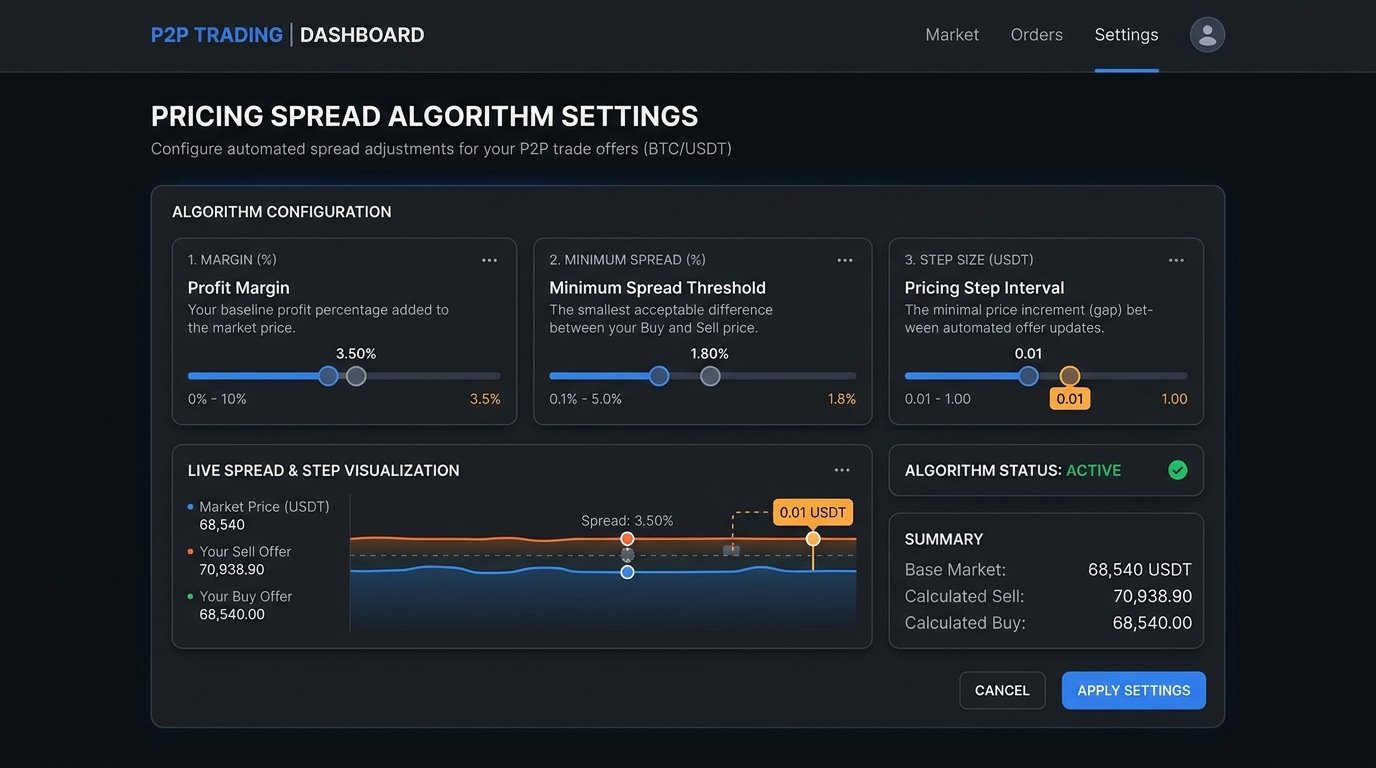
In modern P2P arbitrage, your ad's position in the order book is only the first step toward a completed trade. The real battle for profit unfolds not just in the price table, but in order processing speed, security, and the system's ability to operate around the clock.
Pilotbotnet is not just a price-updating script. It is a full-fledged high-end SaaS ecosystem that powers the Zero Manual cycle. It is integrated with Binance, Bybit, OKX, and HTX, supporting absolutely all fiat pairs and payment methods available on these exchanges, whether it's NGN, THB, or RUB.
Let's explore how the four-stage Zero Manual pipeline is designed, allowing you to earn while you sleep.
The "Zero Manual" Pipeline: 4 Stages of Autonomy
Many mistakenly assume that automation ends with shifting prices. In reality, that is merely the foundation.
Step 1. AI-Repricing: Dominating the Order Book 24/7
To capture the bulk of market liquidity, your ad must stay in the TOP-1 spot. The Pilotbot worker analyzes the order book and adjusts your price with millisecond latency. You define the limits and target margin — the system ensures you win trades at the best possible rate. A human with manual delays cannot compete here.
Step 2. AI Chat Agent: Autonomous Customer Interaction
As soon as an order is opened, the AI agent steps in. It automatically greets the buyer, handles objections, and requests receipts when necessary.
Important: The AI Chat Agent never sends payment details on its own initiative. It acts as an intelligent first-line filter.
Step 3. Strict AML/KYC and Secure Payment Detail Dispatch
The next barrier for fraudsters is identity verification. Pilotbotnet is integrated with enterprise solutions like Didit and can also request a selfie with ID directly in the chat, cross-referencing names against databases.
Only after the customer passes verification does the system's deterministic security layer (not the AI) send your bank details or QR code into the chat. Scammers are left with nothing: the system simply refuses to disclose transfer details to unverified users.
Step 4. Bank API: Instant Auto-Release
Automatic crypto release (Auto-release) is the pinnacle of the Pilotbotnet ecosystem. Thanks to bank API integrations (Stark Bank / Pix, Tinkoff, Monobank via webhooks), the system automates what used to consume the lion's share of your time:
- Matches the exact incoming transfer amount.
- Matches the sender's name (Confirmation of Payee) or Tax ID with the verified customer data on the exchange.
If the data matches perfectly, the system automatically triggers the "Release Crypto" button.
You no longer need to wake up at 3 AM for a $50 order — the bank API will verify the incoming payment, match the sender's name, and release crypto in 12 seconds.
Summary
Why spend hours monotonically refreshing the page, checking bank balances, and answering chats when a machine does it faster, safer, and 24/7? On Binance, Bybit, OKX, and HTX, the winner isn't the one who sleeps less, but the one who leverages technology. Build your business, and leave the routine to Pilotbotnet.
Automate P2P Trading and Keep Top Order Book Positions 24/7
Get 28 days of Light plan free instead of 14 with the exclusive promo code below. No credit card required.
Maksim
Founder, Pilotbot
Builds Pilotbot, a P2P Trading OS for merchants running advertisements across Binance P2P and Bybit P2P. Works on automated pricing, ad positioning and exchange connectivity.