True Math of P2P Arbitrage: Net Spread and Fee Traps
A breakdown of real P2P trading economics: 2026 fee schedules for Bybit and Binance, hidden fee leakage and the True Net Spread formula.

Maksim
Author
On this page
- 1. The Anatomy of Margin Leakage: 4 Hidden Friction Layers
- The Canonical True Net Spread Formula:
- 2. 2026 Verified P2P Exchange Fee Benchmark (USDT Pairs)
- 3. Why the Best Price Does Not Guarantee Top-1: The Bybit Ranking Algorithm
- 4. Practical Breakdown: 1,000 USDT Round-Trip Cycle (Taker → Maker)
- 5. Human Biological Limits vs The Pilotbot Execution Engine
- How the Pilotbot Technology Pipeline Solves This:
- 6. Pre-Flight Merchant Checklist
A classic trap for aspiring P2P merchants: "I see a 2.0% gross spread between buy and sell ads in the order book, let's deploy all available trading capital!" The trader spends 12 exhausting hours glued to the screen, pressing F5 every 30 seconds, completing dozens of orders, and seeing an apparent $1,400 profit on the exchange dashboard. Yet the next morning, when reconciling bank accounts and crypto wallets, they discover their real balance is down by $300.
Where did the profit evaporate? The culprit is the "leaky bucket" reality of P2P trading: uncalculated maker fees, interbank transfer surcharges, execution latency slippage, and invisible exchange ranking algorithms that push manual traders into toxic liquidity.
In institutional P2P arbitrage, winners do not chase illusory gross spreads. They calculate their True Net Spread down to the cent and deploy automated execution to dominate the order book.
1. The Anatomy of Margin Leakage: 4 Hidden Friction Layers
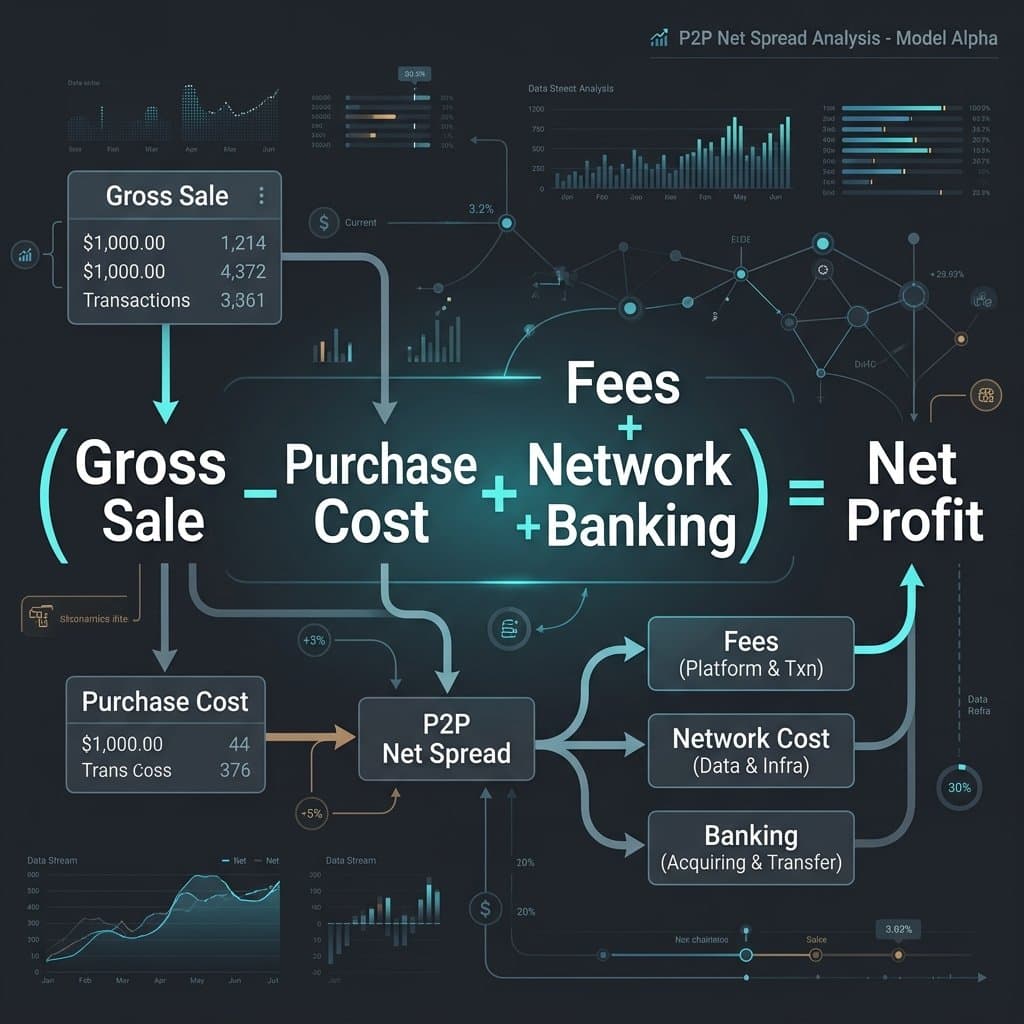
In live trading, gross spread is merely the visible surface: $$\text{Gross Spread} = \frac{P_{sell} - P_{buy}}{P_{buy}} \times 100%$$
To ensure a round-trip cycle yields real net cash rather than balance deficits, professional merchants dissect costs across 4 distinct layers:
- Exchange P2P Fees (Maker vs Taker): Retail takers (users filling existing ads) trade at 0.00% platform fees across major global venues. However, makers (merchants posting liquidity ads) encounter tiered schedules: 0.00% on Bybit (for 95% of fiat pairs), up to 0.30% on Bybit RUB/NGN, and 0.10%–0.35% on Binance P2P.
- Banking Gateways & Interbank Limits: Wire transfer fees, cross-border payment provider charges, instant settlement surcharges (SEPA instant, Faster Payments, Pix, ACH), and account maintenance overhead quickly consume 0.5% to 1.5% of gross margin.
- Latency Slippage (The Cost of Manual Delay): While a manual merchant opens their mobile banking app, checks SMS codes, and releases crypto (taking 3 to 7 minutes), spot market prices drift. Arbitrageurs end up fulfilling trades against an adverse market move.
- Blockchain Network Fees (Withdrawal & Rebalancing): Moving working capital between platforms over TRC-20 costs ~$1.00–$2.50 per transfer. On frequent cycles with modest capital, this burns 0.2%–0.4% of turnover. Switching to low-cost networks like BSC (BEP-20) or Arbitrum reduces this cost to pennies.
The Canonical True Net Spread Formula:
$$\text{Net Profit} = (V_{sell} - V_{buy}) - (Fee_{maker} + Fee_{taker_flat} + Fee_{bank} + Fee_{network})$$
2. 2026 Verified P2P Exchange Fee Benchmark (USDT Pairs)
Confusing spot exchange commissions with P2P trading rules is a fatal analytical error. Below is the verified fee framework across primary global P2P platforms for 2026:
| Exchange | Taker Fee | Maker Fee | Merchant Tiers & Fee Discounts | Collateral Deposit |
|---|---|---|---|---|
| Bybit P2P | 0.00%<br>(Excl: AZN 0.25%) | 0.00% (for 95% of world currencies: USD, EUR, THB, VND, BRL, KZT).<br>RUB Sell Ads: General — 0.30%, Verified — 0.275%, Block — 0.25%.<br>NGN Buy Ads: 0.25%–0.30%. | General → Verified → Block.<br>Rebates of 10%–20% or a 3,000 USDT flat cap for high-volume merchants (> $250k/mo). | 1,000 USDT in Funding Account.<br>(Bybit VIP 2+ users exempt from deposit). |
| Binance P2P | 0.00% base.<br>(Note: Flat Fee of 0.06–0.08 USDT on USDT pairs in 80+ fiats!) | 0.10% – 0.35%:<br>• 0.10%: CIS region (GEL, KGS, TJS, AZN, AMD).<br>• 0.15%: THB, INR.<br>• 0.20%: NGN, KES.<br>• 0.25%: COP, VES, BOB, PEN.<br>• up to 0.35%: exotic fiats. | Bronze → Silver → Gold (VIP).<br>• Bronze: -20%<br>• Silver: -30% (volume $\ge$ 200k USDT)<br>• Gold: -50% (volume $\ge$ 2M USDT) | Standardly 0 (screened via KYC/volume). High-risk corridors require 1,000–3,000 USDT. |
⚠️ Binance Micro-Order Alert: On small orders (10–20 USDT), the flat taker fee of 0.08 USDT represents an effective deduction of 0.4%–0.8%. Factor this into your order sizing thresholds.
3. Why the Best Price Does Not Guarantee Top-1: The Bybit Ranking Algorithm
Manual traders often assume: "I'll price my ad 0.01 tick lower than the competition and capture 100% of incoming volume." In reality, Bybit implements a multi-tier sorting cascade (P2P Advertising Sorting Rules):
- Top Picks for New Users (Tier 1 Priority): A curated showcase for first-time traders. Only Verified Advertisers (VA) with low entry limits ($\le 100$ USDT) are eligible.
- Special Recommendation (Tier 2 Priority): Top 5 verified merchants with proven liquidity and fast release history.
- Advertiser Identity Tie-Breaker: When multiple sellers set the exact same price, Bybit ranks them strictly by account tier: $$\mathbf{Block\ Advertiser\ (BA)} > \mathbf{Verified\ Advertiser\ (VA)} > \mathbf{General\ Advertiser\ (GA)}$$ An unverified merchant cannot appear above a verified merchant at equal prices.
- Dynamic Scoring Engine (0–100 Score):
In major fiat markets, Bybit computes an algorithmic composite score based on:
- Price Competitiveness Index: Deviation of the ad's price from the weighted average execution price of real trades over the preceding 1 hour.
- 30-Day Completion Rate: Proportion of completed trades (target benchmark: $\ge 98%$).
- Average Release Time: Speed of releasing crypto upon payment confirmation.
- 30-Day Anti-Smurf Filter: Accounts under 30 days old are restricted from Top-20 visibility.
A manual trader simply cannot compete: algorithmic repricing bots adjust prices by 0.01 tick within 200–500 ms, pushing manual ads to page 2 where taker traffic drops by 85%.
4. Practical Breakdown: 1,000 USDT Round-Trip Cycle (Taker → Maker)
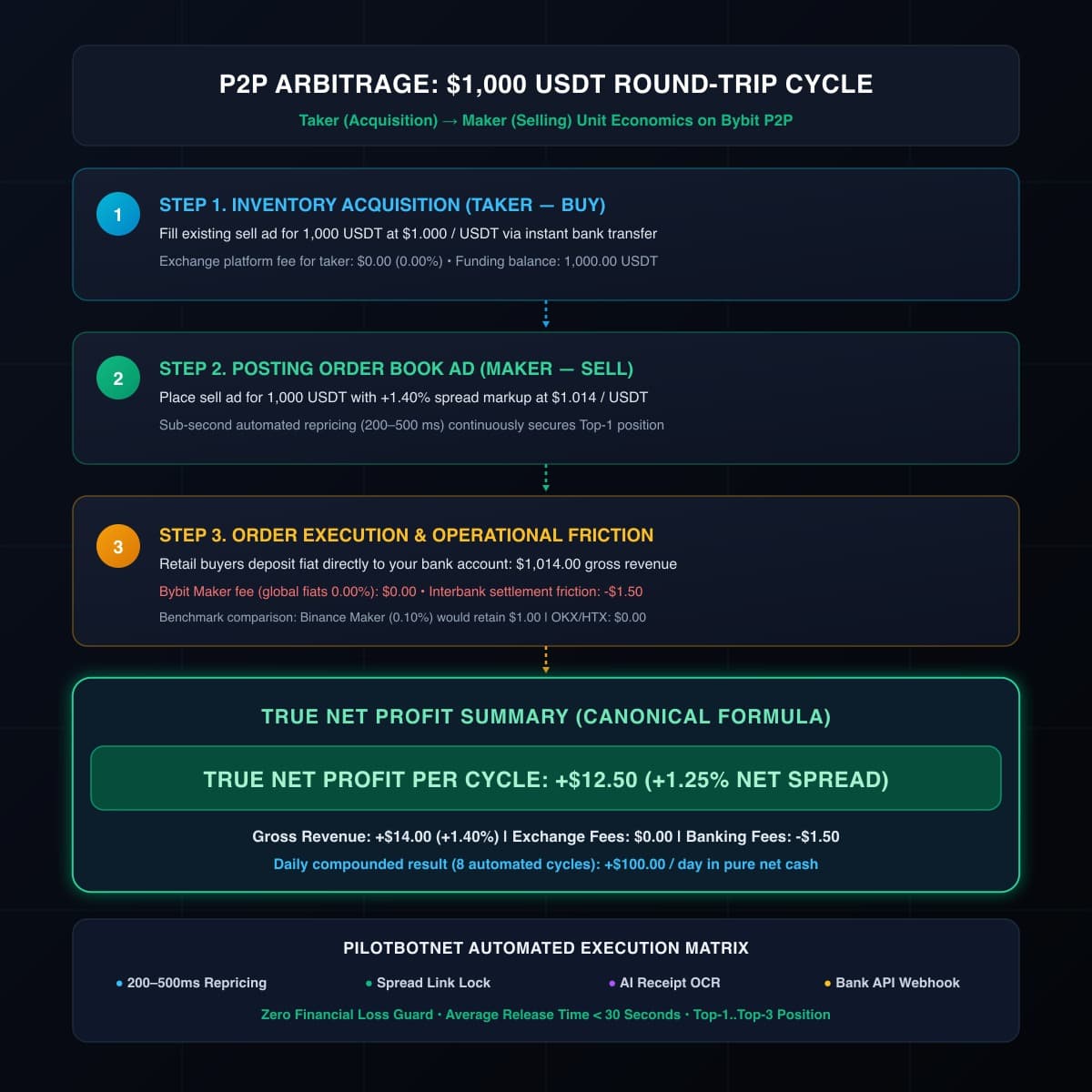
Let's examine the exact unit economics of a standard 1,000 USDT capital cycle on Bybit P2P using the industry-standard Taker (Acquisition) → Maker (Selling) strategy:
- Step 1. Inventory Acquisition (Taker, 0% platform fee): You take an existing sell ad for 1,000 USDT at an exchange rate of $1.000 / USDT (or local fiat equivalent, e.g. 36.00 THB / 25,400 VND). You transfer the exact fiat amount via instant bank transfer. Exchange Fee: $0.00. Funding balance credited: 1,000.00 USDT.
- Step 2. Posting Order Book Ad (Maker): You place your own sell ad for 1,000 USDT with a +1.40% spread markup at $1.014 / USDT.
- Step 3. Order Execution & Platform Fee: Retail buyers purchase your volume in tranches, crediting your bank account with $1,014.00. On Bybit P2P for international currencies (USD, EUR, THB, VND, BRL), the maker fee is 0.00%. (Note: On Binance P2P with a 0.10% maker rate, the platform would retain 1.00 USDT, yielding $1,012.99).
- Step 4. Banking Gateway Friction: Interbank or fast payment settlement costs: $1.50.
- Net Financial Result:
- Gross Revenue: $1,014.00 - $1,000.00 = +$14.00 (+1.40%).
- Exchange Fee: $0.00.
- Banking Fees: -$1.50.
- True Net Profit: +$12.50 (+1.25% Net Spread) in a single 15-minute cycle.
Running 6 to 10 automated cycles daily on a 1,000 USDT capital base generates $75.00 to $125.00 in pure net daily earnings.
5. Human Biological Limits vs The Pilotbot Execution Engine
Running a manual P2P operation inevitably runs into fatal bottlenecks:
- Cognitive Fatigue & Costly Errors: After 4 hours of screen surveillance, human operational errors increase by 300% (decimal misplacements, releasing escrow before bank verification).
- Fraudulent Receipts & Triangle Scams: Scammers generate fabricated PDF receipts with functional QR codes and altered recipient lines. At 3:00 AM, human eyes fail to detect sophisticated forgery.
- Execution Slippage: When underlying crypto markets shift, manual ads become severely underpriced. Arbitrage sniper bots sweep the ad before the merchant can click cancel, locking in a direct loss.
How the Pilotbot Technology Pipeline Solves This:
- Sub-Second Automated Repricing (200–500 ms): Automated worker engines continuously scan order books on Bybit and Binance, keeping your ad locked into Top-1..Top-3 positions without manual intervention.
- Capital Protection (Spread Link & Stop-Loss): Mathematical rules prevent the system from ever selling below your designated net profitability threshold. When market spreads narrow, the bot pauses your listing automatically.
- AI Receipt Validation: Optical character recognition algorithms inspect incoming slips for payer name consistency, transaction reference IDs, and timestamp authenticity.
- Direct Bank API Integration: Automated release triggers immediately upon verified bank webhooks, slashing average release times to under 30 seconds and boosting account standing in exchange algorithms.
6. Pre-Flight Merchant Checklist
Before launching your daily trading operations, verify:
- The exact maker fee tier on your selected exchange and fiat market.
- Daily banking transfer quotas and interbank settlement charges.
- Your merchant standing (Verified status gives critical priority in order book tie-breakers).
- An active Spread Link threshold protecting you from negative fills.
- Repricing latency under 1 second to avoid toxic arbitrage fills.
🎁 Exclusive Merchant Perk: Activate 28 days of free Light tier access upon registration with Pilotbot to unlock automated order book management and real-time Net Spread calculation.
Automate P2P Trading and Keep Top Order Book Positions 24/7
Get 28 days of Light plan free instead of 14 with the exclusive promo code below. No credit card required.

Maksim
Founder, Pilotbot
Builds Pilotbot, a P2P Trading OS for merchants running advertisements across Binance P2P and Bybit P2P. Works on automated pricing, ad positioning and exchange connectivity.